
Comparison
Plantation Shutters vs Blinds: Which is Right for Your Home?
An installer's honest take, from 1996 to now, on when shutters are worth the premium, when blinds are the smarter call, and why most Georgia homes end up with a mix of both.
The choice, framed honestly
Two categories, very different jobs in the home.
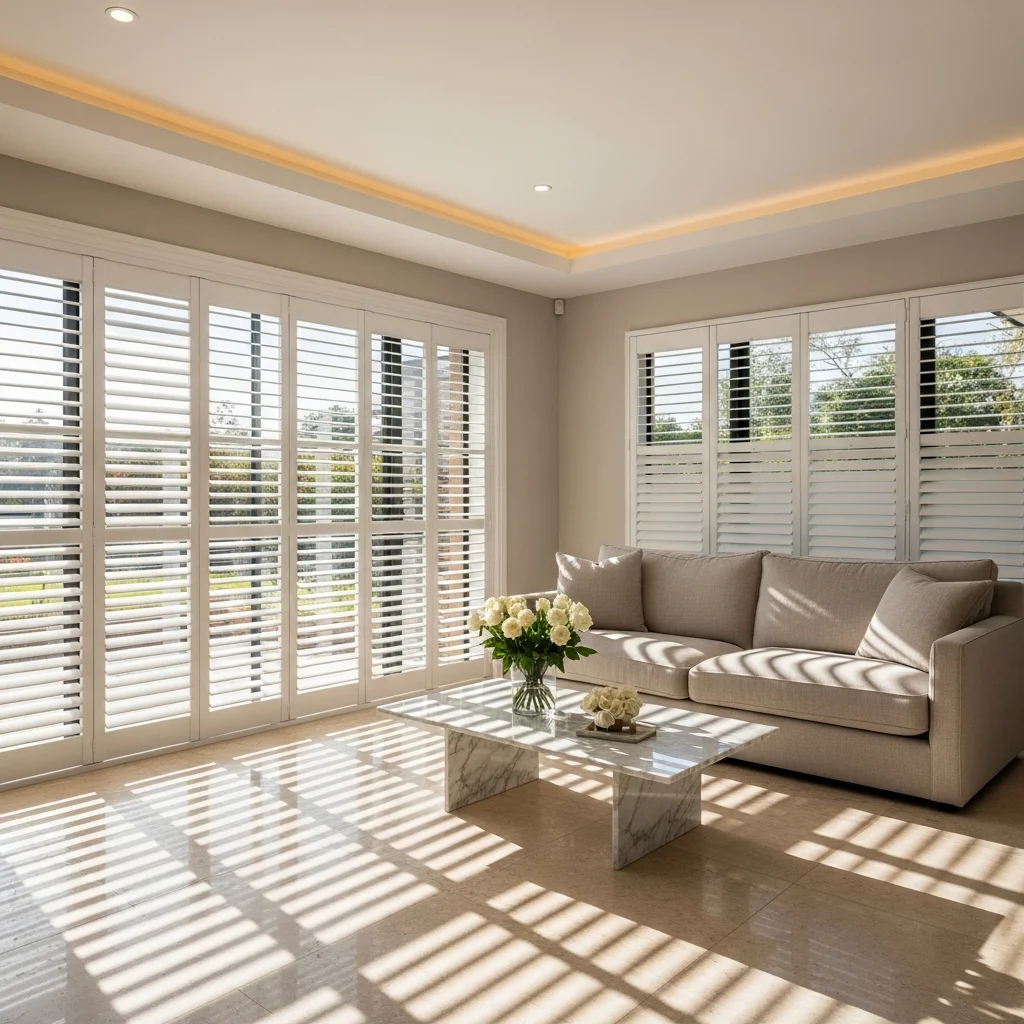
Plantation shutters and custom blinds are not really competing products in the same category. Plantation shutters are a built-in architectural feature; blinds are a functional window covering. Both control light, both provide privacy, both come in many materials. But they sit at different price points, last different lengths of time, and add different things to a home. Choosing between them is more about what role you want the window covering to play in the room than which one is "better."
We have installed both across Atlanta, Buckhead, Sandy Springs, Roswell, Alpharetta, Marietta, Smyrna, Douglasville, Carrollton, Cartersville, Rome, and Columbus since 1996. The decision pattern is consistent: shutters in the public rooms that carry the architectural statement, blinds or shades in the back-of-house rooms where function matters more than form. Roughly 70 percent of our Greater Atlanta whole-house installs end up as a mixed package; pure-shutter and pure-blind houses are the minority.
This guide breaks the decision down honestly, room by room, with real numbers. The plantation shutters cornerstone and the blinds cornerstone cover the product specifics; this page is about the choice between them.
Head-to-head, by category
How they compare on the seven things that matter.
Cost per window
Blinds win. Custom blinds run $200 to $650 per window installed in Georgia; plantation shutters run $400 to $1,500 per window. For a 20-window house, blinds save $4,000 to $17,000 upfront. The savings are real, but lifespan changes the per-year math.
Lifespan and replacement cycle
Shutters win decisively. Plantation shutters last 25 to 30 years on the panel; custom blinds last 8 to 15 years on the slat assembly; vinyl mini-blinds last 4 to 7 years. Over a 25-year ownership, blinds typically get replaced twice; shutters once if at all.
Resale value
Shutters win. Greater Atlanta appraisers credit plantation shutters as a built-in feature that adds 60 to 80 percent of installed cost to appraised value. Blinds are personal property and add minimal appraised value. Listing copy in Buckhead, Marietta, and Roswell frequently calls out plantation shutters by name.
Light control quality
Even. Shutters give cleaner gradient control because each louver bank tilts independently. Blinds give tighter edge management because the slat assembly hugs the window opening. For mood lighting, shutters win; for room darkening, blinds (with side channels) or shades win.
Architectural integration
Shutters win decisively. Shutters frame the window and become part of the architectural language of the room. Blinds disappear when raised and read as functional hardware when lowered. In rooms where the window itself is a design feature (bays, palladiums, picture windows), shutters finish the room; blinds compete with the architecture.
Motorization options
Blinds win. Motorized blinds and shades are more common, lower-cost per opening, and have a wider product selection. Motorized plantation shutter louvers exist (Hunter Douglas, Norman) but cost significantly more per opening and are limited to specific manufacturer lines.
Maintenance
Even. Both wipe down with a damp cloth. Shutters have no cords to detangle or replace; blinds eliminate the cord with motorization or cordless lift systems. Net, both are low-maintenance in 2026 product generations.
When to pick plantation shutters
Shutters are the right call when…
The room is a public architectural space
Living rooms, dining rooms, foyers, formal libraries, primary suites in homes where the window is a design feature. Bay windows, palladiums, picture windows over a sofa, transom-topped openings. These are the rooms where shutters become part of the architecture and add visible value to the home.
You plan to stay in the home 10+ years
The lifespan economics favor shutters when you amortize over a long ownership. Eight to ten thousand dollars in shutters across 25 years is $320 to $400 per year. The same window count in blinds, replaced twice, is comparable per-year cost without the architectural lift or the resale value.
The home is a higher-end build or restoration
Buckhead Tudors, Druid Hills bungalows, Marietta colonials, Roswell traditionals, and the historic Carrollton and Cartersville builds all benefit architecturally from plantation shutters. Builders frequently spec them into new construction at $700k+ price points as a baseline expectation.
You want the lifetime-warranty peace of mind
Plantation shutters from Norman, Hunter Douglas, Allgood, and many others carry lifetime warranties on the frame, panel, and louver hardware. If a hinge sags in year 14 because a child swung from it, we come fix it. Most blinds carry 5 to 10 year warranties that prorate over time.
When to pick custom blinds
Blinds are the right call when…
Budget is the dominant constraint
Custom blinds in faux wood or composite at $200 to $400 per window let you cover an entire house for a fraction of the shutter spend. For a starter home, a rental property, or a temporary stopgap before a longer-term shutter plan, blinds are the practical answer.
The room is back-of-house or utilitarian
Laundry rooms, mudrooms, garage entries, basement spaces, secondary bedrooms used as offices, utility-room windows. Rooms where the window covering needs to function but is not a design statement. Plantation shutters are overkill in these spaces.
You want motorization on a budget
A motorized roller shade or motorized faux wood blind runs $500 to $900 per window installed. A motorized plantation shutter louver runs $900 to $1,800. For a smart-home build covering many windows, blinds and shades give you motorization at a per-opening cost that scales.
You are planning a 3 to 7 year move
If you expect to sell inside a decade, the shutter resale lift may not justify the upfront. Blinds let you cover windows attractively at a price point that does not need to be amortized over decades. Replace with shutters at the next house if you stay longer.
The cost comparison
What the price difference actually looks like.
For a typical 18-window Marietta colonial in 2026 dollars: custom faux wood blinds across the entire house run roughly $5,400 to $9,000 installed. The same 18 windows in painted basswood plantation shutters run $9,800 to $14,000. The shutter premium is $4,400 to $5,000 upfront for an asset that lasts twice as long and adds resale value.
The mixed-spec approach (shutters in public rooms, blinds or shades in back-of-house) typically lands midway. The same 18-window Marietta colonial with shutters in 10 public-facing rooms and blinds in 8 back-of-house rooms runs $8,200 to $11,400, with the architectural statement where it matters most and budget discipline where it does not.
For a 5-year ownership plan, blinds are clearly cheaper. For a 15+ year plan, the per-year cost converges and shutters win on resale and architectural value. For the typical Atlanta homeowner planning to stay 8 to 12 years, the mixed spec is the most defensible economic choice.
Final price comes from in-home measure. No obligation. 50% deposit, balance install day.
Real-world room-by-room calls
How the decision actually goes in a Georgia home.
Atlanta Virginia-Highland bungalow living room
Three bay windows under a wide picture frame, 1920s craftsman trim, formal living space. Stained basswood plantation shutters in a custom oak match, 3.5 inch louvers, decorative L-frame. Installed at $2,400 for the three openings. Blinds would functionally work but visually compete with the original picture-rail trim.
Roswell 4-bedroom new build, secondary bedrooms
Three children's bedrooms, standard sized double-hung windows, no special architectural features. Custom faux wood blinds with cordless lift in white. Installed at $1,050 for the three rooms. Plantation shutters were considered but the homeowner wanted budget headroom for shutters in the public rooms; faux wood blinds did the job at one-third the cost.
Marietta whole-house, mixed package
3,400 sqft East Cobb traditional, 22 windows. Plantation shutters in painted basswood across the foyer, living room, dining room, primary suite, and library (12 openings). Cellular shades with cordless lift in the 4 secondary bedrooms, faux wood blinds in the 3 baths and laundry, motorized roller shade in the basement media room. Installed total: $13,400. The mixed spec balanced architectural lift with budget discipline.
Being a first time homeowner, I could not trust myself to get all the details correct. Lucky for us, we had purchased a home in one of your local service areas. Michael Busbin, our representative, was at our home right on time within two hours of our call. Our custom dimensioned blinds were installed in 4 days, shades were in 6 days and the shutters were 18 days later.Robbie Martin, Senoia, GA
Where we install both
Across Greater Atlanta and West Georgia.
Questions homeowners ask
The decision, in plain terms.
Which lasts longer, plantation shutters or blinds?
Plantation shutters last 25 to 30 years on the panel. Custom blinds (real wood, faux wood, aluminum) last 8 to 15 years on the slat assembly. Vinyl mini-blinds last 4 to 7 years before cord wear and slat brittleness force replacement. Shutters are built more like cabinetry; blinds are built more like consumer goods. The lifespan difference is real and consistent across brands.
Which is cheaper, plantation shutters or blinds?
Blinds are cheaper upfront. Custom blinds in Georgia run $200 to $650 per window installed; plantation shutters run $400 to $1,500 per window installed. Over a 20-year window, the shutter math comes closer to even because blinds need to be replaced once or twice in the same period. For a forever-home plan, the per-year cost converges; for a 5-year-stay-then-sell plan, blinds are clearly cheaper.
Do plantation shutters add more resale value than blinds?
Yes. Real estate appraisers in Greater Atlanta typically credit plantation shutters as a built-in feature that transfers with the home and adds 60 to 80 percent of installed cost to appraised value. Blinds are treated as personal property that may or may not stay with the home and add minimal appraised value. Plantation shutters in Buckhead, Marietta, and Roswell builds frequently get called out in listing copy as a value-add.
Which gives better light control, shutters or blinds?
Both deliver excellent light control when fully closed. Shutters offer cleaner gradient control because each louver bank can be tilted independently top to bottom. Blinds offer finer light-leak management at the edges because the slat assembly hugs the window opening more tightly. For full blackout in a bedroom, side-channel blackout fabric blinds or shades typically outperform shutters; for daily light modulation in a living room, shutters give the smoother control.
Which works better with motorization?
Motorized blinds and shades are more common because they are simpler to motorize. Motorized plantation shutter louvers exist but are more expensive and limited to certain manufacturer lines. For a smart-home build with full automation, motorized shades or blinds are the practical default; for a few rooms where motorized convenience matters most, motorized shutters are workable. See our motorized shades cost page for the Atlanta pricing.
Can I mix plantation shutters and blinds in the same house?
Yes, and many homeowners do. A typical mixed-spec install: plantation shutters in the public rooms (living, dining, foyer, primary suite) where they add architectural value, plus motorized roller or cellular shades in the bedrooms for light control. The shutters carry the architectural statement; the shades carry the functional convenience. This is the most common high-end Atlanta build pattern in 2026.
Begin here
Let us help you spec the right mix room by room.
Tell us where you live and roughly how many windows you have in mind. We will walk through each room on the consult and recommend shutters, blinds, shades, or a mix based on what each opening actually needs.
No obligation. 50% deposit, balance install day. Lifetime warranty on shutters.